
Sports Uniforms: Care, Durability & Sustainability

Sports uniforms represent far more than simple clothing for athletes. They embody team identity, enhance performance, ensure safety, and increasingly reflect environmental values. As we move through 2026, the landscape of athletic apparel continues to evolve with innovations in sustainable materials, advanced fabric technologies, and stricter regulatory standards. For facilities managing these high-performance garments, understanding the unique care requirements and lifecycle considerations of sports uniforms has become essential to maintaining their functionality, appearance, and longevity.
The Evolution of Modern Sports Uniforms
Athletic apparel has undergone dramatic transformation over the past decade. Today's sports uniforms incorporate moisture-wicking fabrics, antimicrobial treatments, and compression technologies that directly impact athlete performance. These technical features require specialized care protocols that differ significantly from standard laundry practices.
The shift toward sustainability has accelerated in 2026. World Athletics' "From Commitment to Impact: 2026" report demonstrates how major sporting organizations are integrating environmental considerations into uniform procurement, including lifecycle practices and material selection. This evolution affects everyone from professional teams to youth sports organizations managing laundry operations.
Performance Fabric Technologies
Modern sports uniforms utilize several advanced fabric technologies:
- Moisture-wicking polyester blends that pull sweat away from skin
- Antimicrobial treatments that reduce odor-causing bacteria
- Compression zones engineered for muscle support
- UV-protective materials for outdoor sports
- Stretchable synthetic fibers that maintain shape through repeated wear
Each technology presents specific laundering challenges. Antimicrobial treatments can degrade with harsh detergents, while compression fabrics lose elasticity when exposed to high heat or abrasive washing conditions.

Regulatory Standards and Compliance
Sports governing bodies maintain strict regulations regarding uniform specifications. FIFA's Equipment Regulations detail requirements for colors, number placement, and approval procedures that teams must follow. These standards impact not only design but also maintenance practices.
| Sport | Governing Body | Key Uniform Requirements |
|---|---|---|
| Football | FIFA | Contrasting colors, approved materials, specific number fonts |
| Basketball | FIBA | Team color coordination, advertising placement limits |
| Track & Field | World Athletics | Competition number visibility, approved sponsor zones |
| Baseball | MLB | Traditional styling standards, fabric durability minimums |
Compliance extends to how uniforms are maintained. The Laws of the Game 2025/26 includes minimum quality and durability standards that require proper laundering to maintain certification throughout the season.
Branding and Logo Preservation
Uniform branding involves heat-pressed logos, embroidered emblems, and sublimated designs. Each application method demands different care approaches. Heat-pressed graphics can peel or crack when exposed to excessive heat or harsh chemicals, while embroidery withstands aggressive washing but may snag in traditional drum dryers.
Professional teams often manage dozens or hundreds of uniform sets simultaneously. The logistics of sorting, washing, drying, and distributing these garments require industrial-grade solutions that balance efficiency with fabric preservation. Laundry Labs' commercial-grade products are designed specifically for high-volume operations where performance and consistency matter.
Sustainability in Athletic Apparel
Environmental responsibility has become a defining feature of sports uniforms in 2026. Research published in Nature Communications examines how uniforms contribute to the broader ecological footprint of sporting events and supply chains, pushing manufacturers toward circular economy models.
Recycled and Renewable Materials
The design innovations in 2026 World Cup uniforms showcase how major tournaments drive adoption of recycled polyester and renewable fabric sources. These materials offer comparable performance to virgin synthetics while reducing environmental impact.
Teams adopting sustainable uniforms face new care considerations:
- Gentle pH-balanced detergents protect recycled fiber integrity
- Lower temperature washing preserves renewable material properties
- Air drying or low-heat cycles extend garment lifespan
- Biodegradable softeners align with environmental commitments
- Concentrated formulas reduce packaging waste and transportation emissions
Many sports organizations partnering with technology platforms like PerHead Kings for operational efficiency are extending that same data-driven approach to uniform management, tracking laundering costs, garment lifespan, and replacement cycles to optimize both performance and sustainability.
Care Protocols for Different Sport Categories
Sports uniforms vary dramatically by activity type. Contact sports like football and rugby generate heavy soiling with grass stains, mud, and perspiration. Court sports like basketball produce primarily sweat-based soil. Each category requires tailored laundering approaches.
Contact Sports Uniforms
Football, soccer, and rugby uniforms endure extreme conditions:
- Grass and mud stains requiring enzymatic pre-treatment
- Blood removal following strict biohazard protocols
- Reinforced stitching vulnerable to aggressive agitation
- Heavy soil loads demanding powerful yet fabric-safe detergents
For facilities managing contact sport uniforms, athletic-specific laundry solutions offer the concentrated cleaning power needed for heavy soiling while protecting technical fabrics. The combination of stain treatment, odor control, and fabric conditioning in a single formulation streamlines workflows for equipment managers handling tight turnaround schedules.

Court and Indoor Sport Apparel
Basketball, volleyball, and indoor soccer uniforms face different challenges:
- Perspiration-based odors requiring thorough antimicrobial action
- Lighter colored fabrics showing discoloration more readily
- Synthetic meshes trapping body oils and requiring degreasing agents
- Rapid turnaround needs during tournament play
The moisture-wicking properties that make these uniforms effective during competition can work against them in the wash. Residual detergent trapped in synthetic fibers reduces wicking performance and causes skin irritation. Thorough rinsing becomes critical, making powerful, low-residue formulations essential for maintaining uniform performance.
Commercial Laundry Operations for Athletic Programs
Schools, universities, and professional teams operate laundry facilities processing hundreds of uniform pieces daily. These operations require industrial efficiency while maintaining the specialized care sports uniforms demand.
Workflow Optimization
Successful athletic laundry operations implement systematic workflows:
- Collection and sorting by fabric type and soil level
- Pre-treatment application for stains and heavy soiling
- Load programming with sport-specific wash cycles
- Quality inspection before drying to prevent heat-setting stains
- Controlled drying using appropriate temperatures for fabric types
- Immediate folding to minimize wrinkles and maintain presentation
Equipment managers report that pre-portioned laundry capsules reduce dosing errors and speed up processing compared to liquid or powder products. Capsule formulations combining multiple treatment types eliminate the need for separate detergent, softener, stain remover, and odor control products, reducing both labor and storage requirements.
Water and Energy Efficiency
Commercial athletic laundry operations consume significant resources. High-efficiency washers paired with concentrated detergents reduce water usage by 30-40% compared to traditional systems. Cold-water formulas eliminate heating costs while protecting heat-sensitive performance fabrics.
| Efficiency Measure | Water Savings | Energy Savings | Cost Impact |
|---|---|---|---|
| High-efficiency washers | 35-40% | 20-25% | 15-20% reduction |
| Cold-water detergents | 10-15% | 60-75% | 25-30% reduction |
| Optimized load sizing | 20-25% | 15-20% | 10-15% reduction |
| Concentrated formulas | 5-10% | 5-8% | 12-18% reduction |
These efficiency gains matter not only for operational budgets but also for teams committed to environmental responsibility. Athletic programs increasingly view laundry operations as part of their overall sustainability profile.

Stain Removal and Treatment Protocols
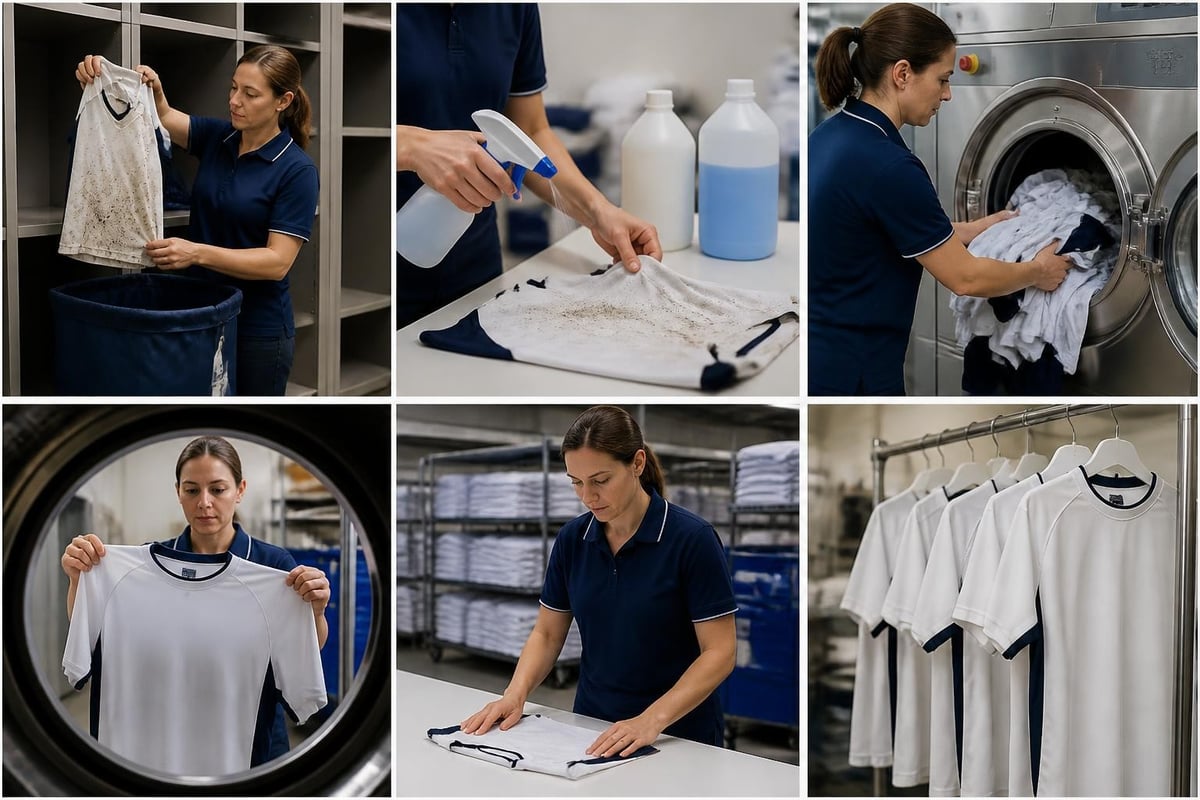
Sports uniforms encounter diverse staining agents requiring targeted treatment approaches. Generic detergents often fail to address the combination of protein-based stains (blood, sweat), tannin stains (grass), and petroleum-based stains (field paint, synthetic turf residue) present on athletic apparel.
Common Athletic Stains and Solutions
Grass stains contain chlorophyll and tannins. Enzymatic pre-treatments break down the plant matter before washing. Rubbing or hot water sets grass stains permanently, making proper protocol critical.
Blood stains require cold water and oxidizing agents. Heat coagulates blood proteins, making removal nearly impossible. Athletic departments must establish biohazard handling procedures for bloodied uniforms.
Mud and clay respond to mechanical action but can become embedded in fabric weave. Pre-soaking loosens soil particles before agitation. Commercial-grade formulations provide the surfactant strength needed to lift heavy soil without excessive mechanical wear.
Synthetic turf residue includes rubber crumb and field paint. These petroleum-based stains require degreasing agents. Many general-purpose detergents lack the solvent power to fully remove these materials.
Pre-Treatment Strategies
Equipment managers maximize stain removal through systematic pre-treatment:
- Apply stain-specific treatments immediately after games when possible
- Avoid heat exposure before stain treatment (no hot water, no dryers)
- Use appropriate brush tools for mechanical stain loosening
- Allow enzymatic treatments adequate dwell time (15-30 minutes minimum)
- Inspect uniforms before drying to prevent heat-setting residual stains
Teams processing uniforms immediately after competition achieve significantly better stain removal rates than those allowing soiled garments to sit overnight. The chemistry of stain oxidation and fiber penetration works against delayed treatment.
Odor Control in Athletic Apparel
Perspiration-soaked sports uniforms present unique odor challenges. Bacteria metabolizing sweat proteins produce malodorous compounds that bond to synthetic fibers. Standard detergents may clean visible soil while leaving odor-causing bacteria and residual compounds intact.
The Science of Sports Uniform Odor
Athletic odor stems from bacterial activity in moisture-rich environments. Synthetic performance fabrics, while excellent for wicking moisture during activity, create ideal conditions for bacterial growth in the post-game environment. The same fibers that pull sweat away from skin also trap bacteria and their metabolic byproducts.
Understanding laundry fragrance science helps explain why masking odors with strong scents proves less effective than eliminating odor-causing bacteria. Antimicrobial wash additives target the source rather than covering symptoms.
Long-Term Odor Prevention
Chronic uniform odor-the "permanently sweaty" smell that persists despite washing-indicates bacterial colonization deep within fabric fibers. Resolving this requires:
- Enzymatic treatments that break down trapped protein residues
- Antimicrobial agents that eliminate bacterial populations
- Deep cleaning cycles with extended wash times
- Thorough rinsing to remove all residual detergent and soil
- Complete drying to prevent moisture-related bacterial regrowth
Teams struggling with persistent uniform odor often discover that switching to comprehensive treatment formulations designed specifically for athletic wear resolves issues that general detergents could not address.
Color Fastness and Fabric Preservation
Sports uniforms represent significant investments. Professional team uniforms can cost $200-500 per complete set, while youth sports organizations budget $50-100 per uniform. Extending garment lifespan through proper care directly impacts program budgets.
Factors Affecting Uniform Longevity
Several laundry practices accelerate uniform degradation:
- Over-agitation causing fiber breakdown and logo damage
- Excessive detergent leaving residues that attract soil
- High temperatures degrading elastic fibers and synthetic materials
- Chlorine bleach weakening fabrics and fading colors
- Improper drying causing shrinkage and elastic failure
Color preservation depends on using color-safe oxidizers rather than chlorine bleach, washing in appropriately sized loads to minimize friction, and selecting detergents formulated to maintain dye integrity. Teams frequently discover that free and clear formulations without optical brighteners better preserve dark colored uniforms compared to standard detergents.

Fabric Softener Considerations
Traditional fabric softeners coat fibers with lubricating chemicals that reduce friction. While this creates a soft feel, it interferes with moisture-wicking performance in technical athletic fabrics. The coating reduces fabric breathability and absorption.
Modern formulations designed for performance apparel provide anti-static benefits without compromising technical properties. Equipment managers should verify compatibility with uniform manufacturer recommendations before implementing softening agents.
Team Identity and Uniform Presentation
Beyond functionality, sports uniforms serve as powerful symbols of team identity. Crisp, well-maintained uniforms project professionalism and pride. Faded colors, pilling fabric, and damaged logos undermine team image and can affect player confidence.
Presentation Standards by Competition Level
Youth sports often prioritize cost-effectiveness, accepting shorter uniform lifespans in exchange for budget constraints. High school and college programs balance durability with appearance standards. Professional teams maintain exacting presentation requirements, often replacing uniforms showing any signs of wear.
These different standards influence laundry product selection. High-volume youth programs might prioritize cost per load, while professional teams focus on gentle, preservative care regardless of price. Commercial laundry solutions scaled for different operation sizes allow programs to match care quality to their specific requirements and standards.
Managing Multiple Uniform Sets
Many teams maintain home, away, and alternate uniform sets. This rotation allows proper drying time between uses and extends overall garment life. Tracking systems ensure even distribution of wear across sets and identify pieces requiring repair or replacement.
Equipment managers report that proper rotation combined with appropriate care can extend uniform set lifespan from one season to three seasons or more, generating substantial cost savings. The investment in quality laundry products pays for itself through reduced replacement frequency.
Environmental Impact and Lifecycle Management
The environmental footprint of sports uniforms extends beyond initial production. Care practices throughout the garment's useful life contribute significantly to overall impact. Water consumption, energy usage, chemical discharge, and eventual disposal all factor into sustainability calculations.
Extending Garment Life Reduces Waste
Each additional season of uniform use defers manufacturing impact. Proper laundering that preserves fabric integrity directly reduces the environmental burden of replacement production. Teams committed to sustainability increasingly view laundry operations as environmental initiatives rather than simple maintenance tasks.
Eco-friendly laundry products minimize chemical discharge into water systems while maintaining cleaning effectiveness. Plant-based surfactants, biodegradable formulations, and concentrated products reducing packaging waste align with broader sustainability goals. Eco-friendly commercial solutions demonstrate that environmental responsibility and performance excellence need not be mutually exclusive.
End-of-Life Considerations
When sports uniforms reach end-of-service, responsible disposal or recycling prevents textile waste. Some organizations donate retired uniforms to youth programs. Others participate in textile recycling programs that repurpose synthetic fibers. Advanced programs partner with manufacturers offering take-back initiatives for material recovery.
The circular economy approach to sports uniforms-designing for durability, maintaining for longevity, and recycling at end-of-life-represents the future of sustainable athletic apparel management. Proper care practices form the essential middle phase of this lifecycle.

Cost-Benefit Analysis of Proper Uniform Care
Athletic programs face constant budget pressures. Understanding the financial case for investing in proper uniform care helps justify quality laundry products and protocols.
Direct Cost Comparisons
| Scenario | Annual Uniform Cost | Laundry Product Cost | Total Annual Cost | Cost per Athlete |
|---|---|---|---|---|
| Budget detergent, annual replacement | $15,000 | $800 | $15,800 | $316 |
| Quality detergent, biennial replacement | $7,500 | $1,400 | $8,900 | $178 |
| Premium care, triennial replacement | $5,000 | $1,800 | $6,800 | $136 |
These calculations assume a 50-athlete program with $150 per uniform set. The data demonstrates that premium laundry products generating the highest per-load cost actually produce the lowest total cost of ownership through extended garment life.
Hidden Costs of Inadequate Care
Poor laundry practices generate costs beyond direct replacement:
- Staff time addressing stain complaints and uniform issues
- Reputation impact from poor team appearance
- Player satisfaction affecting morale and retention
- Replacement urgency forcing rushed purchases at higher prices
Equipment managers report that systematic, quality-focused laundry protocols reduce their workload compared to reactive approaches addressing repeated problems with inadequate solutions.
Best Practices for Athletic Laundry Management
Successful athletic programs implement comprehensive laundry management systems rather than ad-hoc approaches. These systems combine appropriate products, proven protocols, and consistent execution.
Standard Operating Procedures
Documented procedures ensure consistent results regardless of which staff member handles laundry duties:
- Sorting protocols defining categories and load sizes
- Pre-treatment standards specifying products and dwell times
- Wash programming with sport-specific cycle parameters
- Inspection checkpoints preventing defects from advancing
- Drying specifications protecting fabrics and graphics
- Distribution systems returning uniforms to correct athletes
Written procedures also facilitate training for new staff and provide accountability measures for quality control.
Product Selection Criteria
Equipment managers should evaluate laundry products against specific criteria:
- Cleaning power appropriate for typical soil levels
- Fabric compatibility with technical performance materials
- Odor elimination rather than masking
- Color safety preserving uniform appearance
- Environmental profile aligning with organizational values
- Ease of use reducing dosing errors and training requirements
- Cost effectiveness measured in total cost of ownership
Comprehensive laundry capsules that combine multiple treatment functions in single-dose formats score highly across these criteria for many athletic programs.
Sports uniforms in 2026 represent sophisticated technical garments requiring specialized care to maintain performance, appearance, and durability. The intersection of sustainability initiatives, regulatory standards, and advanced fabric technologies demands laundry solutions that deliver powerful cleaning while protecting environmental values and preserving fabric integrity.
Laundry Labs provides commercial-grade, eco-friendly laundry solutions specifically designed for the demanding requirements of athletic apparel, combining detergent, stain treatment, odor control, and fabric conditioning in efficient capsule formulations that help teams maintain professional standards while extending uniform lifespan and reducing environmental impact.
